


Ten years ago, Parkinson’s entered our relationship like an uninvited third wheel.
We used to entertain like it was a performance ... rehearsals, scene painting, choreography ... There were multi-course menus. Elaborate centerpieces. Music curated in advance. Desserts that required refrigeration strategy.
We enjoyed it — or at least we believed we did. In retrospect, I remember being too exhausted to really enjoy the meal while having a kitchen nightmare to clean up.
Now we entertain differently. 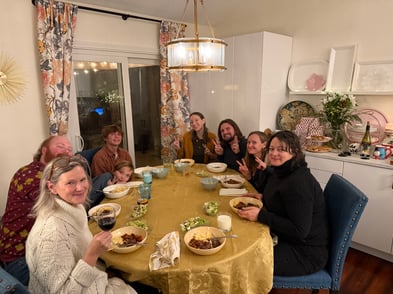
We light fewer candles.
We cook fewer dishes.
We invite fewer people.
And somehow, it is better.
Entertaining after 60 is not about proving capacity. It is about creating connection without depletion.
Energy is not what it once was — particularly in a household navigating Parkinson’s — but attention is sharper. We notice what works. We notice what lingers.
We have learned that the right six people are more interesting than the wrong twelve.
We serve food that can survive interruption. Things that rest well. Dishes that forgive distraction.
There is no longer a moment in the evening where I disappear into the kitchen for 40 minutes while conversation continues without me. If it cannot be prepared mostly in advance, it does not make the cut.
Elegance now means ease.
I hope our guests feel it. When the host is not frantic, the room settles. When expectations soften, conversation deepens.
We start earlier. End earlier. No one resents it.
There is a freedom in abandoning the imaginary audience — the one that once judged whether the napkins matched or the dessert impressed.
Now, the only measure is this: Did we sit down long enough to talk? Did someone laugh? Did someone leave feeling known?
Parkinson’s has added another layer of awareness. Fatigue can arrive without warning. A good day can turn. So we build margins. We keep menus flexible. We protect the following morning.
Hospitality becomes less about display and more about stewardship — of the evening, of energy, of each other. We have also become more willing to accept invitations without reciprocation schedules. Community does not operate on ledger books at this stage of life.
There is something beautiful about gathering in later chapters. Stories are longer. Opinions are more considered. People are less interested in impressing and more interested in understanding.
Entertaining after 60 is not smaller, just more precise. It is less about abundance and more about intention.
And perhaps that is the quiet advantage of time: you finally know what you are trying to create when you open your door.